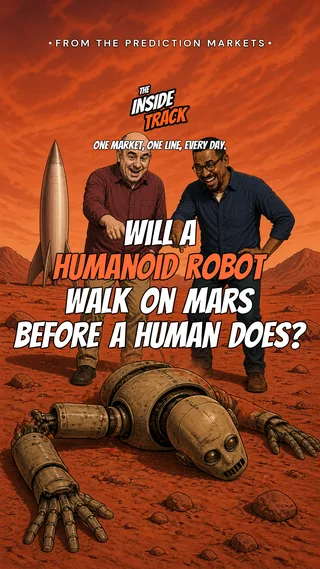
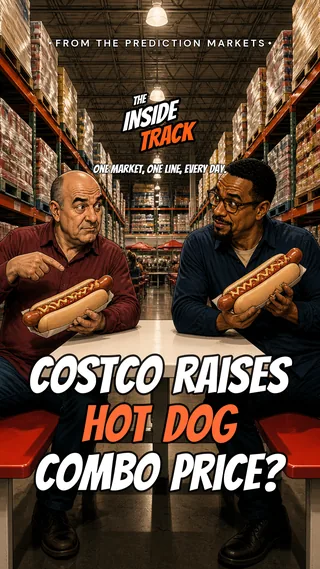
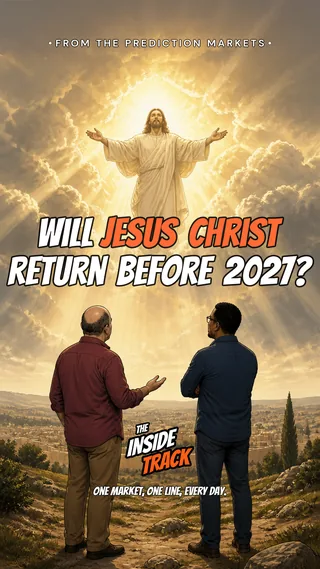
Most people see a sixty-second video and think:
someone wrote a prompt and then an AI made that. If only it were that
simple. Here is what really happens, in order.
It begins at 6am every morning, when an automated production call reads
four betting exchanges in full, shortlists several of thousands of markets
that may be worth sixty seconds of anyone's attention (based on our show
bible), researches them properly, writes a scripted argument between two
characters who do not think alike, generates 11 different accompanying video
assets, assembles it, captions it, and preps it for publishing to six
platforms that each want something slightly different. Then it watches what
happened closely enough to improve the next one.
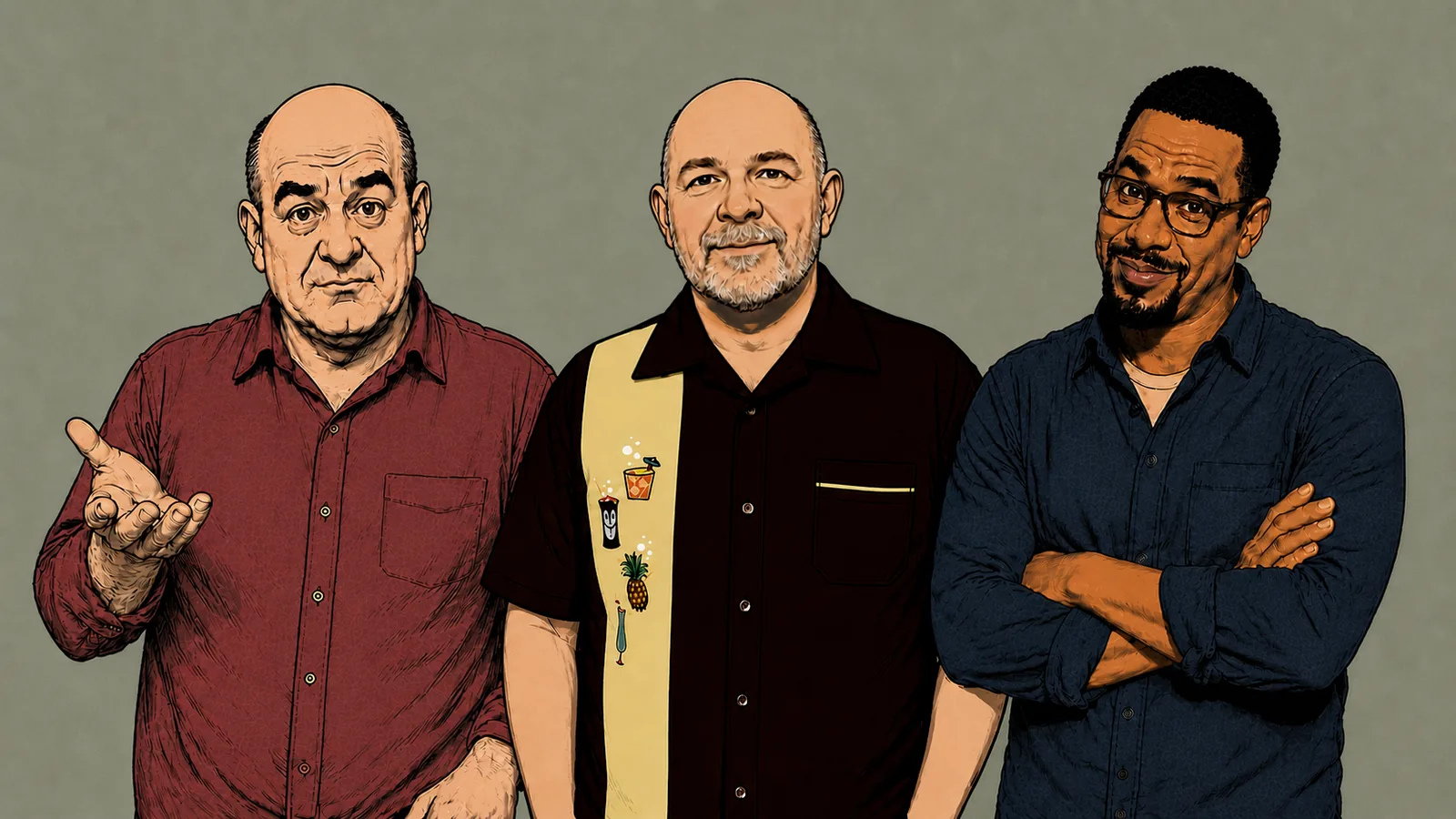
There is one real person on the team. Steve Coulson, the showrunner: he
picks which market to feature each day, writes director's notes for the
‘talent’, and signs off everything that goes out. Everything else
on this page — the researcher, the writer, the talent, the art director, the
camera crew, the editor — are production staff. Very fast, very
literal-minded production staff, who need telling exactly what their job is
without deciding what the show should be.
Where it came from
The idea is older than the technology
This did not begin with “what could an AI generate”. It began
with a particular memory of how having a flutter is treated in Steve’s
home country — and the machinery was chosen afterwards, to serve
that.
It starts with a betting shop, not a computer
The register of this show is English high-street betting culture — the William Hill specials board in the window, the office putting a fiver on the Christmas Number One, a family who never gamble all year having a flutter on the Grand National. That world treats a strange bet as entertainment rather than finance.
The voice is racing coverage, not business news
The model is British bookmakers and tic-tac men and, specifically, the late John McCririck — theatrical, opinionated, gesticulating at a board, genuinely delighted by the absurdity of what people will back. Not CNBC. Not a Senate hearing about whether any of this should be legal. Closer to Siskel and Ebert arguing than to two analysts agreeing.
Prediction markets turned out to be the perfect subject
They are the most accurate real-time measure we have of what people actually believe — thousands of strangers with money at stake tend to beat pundits and polls. They are also, frequently, ridiculous. A market on the Second Coming sits next to a market on the Federal Reserve. That combination of genuine signal and genuine absurdity is the whole show.
So the rule wrote itself: never tip a winner
The moment a show like this says “here is your play”, it becomes a tipping service and the joke dies. The odds are not the story. The bet is the hook; what the bet reveals about us is the payload. Every episode is built to leave you thinking two things — I cannot believe people are betting on that, and huh, that actually tells you something about people.
4 cards — swipe, or use the arrows
Both Sal and Eddie — the stars of the show
— had distinct personalities before either of them said a word on
camera: a bible each, covering how they think, what they notice first, what
they find funny, what they would never say. Sal reads a board for the
signal, not the edge. Eddie cannot get past the fact the question exists.
They disagree about what the odds mean and never about whether you should
bet (you shouldn’t, it is, as they say, a mug’s game). Those
bibles are the foundation for every script that’s written, which is
why the two of them still sound like themselves 89 episodes
later.
The scale of it
What goes in
277,027questions seen since launch
19,140live right now
1,892,579individual odds tracked
4exchanges read daily
Those come from Futuur, Kalshi, Manifold, Polymarket — exchanges where people put real money (and play
money) behind what they think is going to happen. That last number matters more than it
looks: a question priced on one exchange is one crowd's opinion, and reading
four of them means the show can tell when a price is a genuine consensus and
when it is a handful of people in a corner.
Every price is also stored every single day, which is why an episode page
can show you not just where a market stands but where it has been — the
whole line, from before we covered it to now.
Every figure on this page is read from the live system each
time the page is rebuilt. Nobody types them in, and nobody updates them by
hand.
The Research Desk, where markets are scored and selected for an episode.
The floor
Nine steps, not one
1
Find the market
Every morning, four betting exchanges are read in full — every open question, every price, every outcome. That is thousands of live questions before breakfast, and the overwhelming majority of them are no use at all: interest-rate spreads, obscure sports, things already decided, things nobody has staked a penny on.
What survives is scored on one test, and it is not whether the odds are interesting. It is whether two people could argue about it for a minute and you would want to hear the argument. A question about who plays the next James Bond beats a question about bond yields every time, however much money is on the second one.
2
Read the fine print
Before a word is written, the market gets researched properly: who set this price, what moved it recently, what the resolution terms actually say. Prediction markets are full of questions that are not what they appear to be. "Will Johnny Depp be cast in the next Pirates of the Caribbean" sounds like a question about whether he gets the part back. Read the terms and a cameo counts, a voiceover counts, a post-credits wink counts — so it is really a bet on whether Disney can stay annoyed with him for a decade. Same headline, completely different question, and the odds only make sense once you know which one you are looking at.
This is the step that stops the show being confidently wrong in public, and it is the step that most often kills an episode. If the brief comes back and the market is a technicality dressed as a headline, that is a better outcome than finding out after publishing.
3
Write it in two voices
Every Inside Track script is five turns, alternating between the show hosts. Sal handicaps — he reads a board the way a veteran reads a racing form, and he is interested in whether a price is right. Eddie cannot get over the fact that somebody built a market on this at all, and goes looking for what it says about us.
Each turn is written separately, against a character bible, knowing what came before it. That is deliberate and it is more expensive than the alternative: generate the whole conversation at once and both men start sounding like the same person being slightly different.
4
Cast the performance
A script is not a performance. Every line is marked for how it should land — flat, incredulous, delighted, deadpan — before anything is recorded.
This is the least glamorous step and one of the most important. A line that should have been withering delivered as neutral information is a line the audience does not believe, and an audience that stops believing the performance stops believing the show.
5
Record the voices
Both characters have fixed voices. They were chosen in a bake-off, compared side by side, and locked — and when a newer, technically better voice engine came along it was tested and rejected, because it was not quite them any more.
That is the whole argument for holding a voice steady: a character whose voice drifts is not a character, it is a series of narrators. Delivery gets pushed through direction instead — the same actor, given better notes.
6
Generate the performances
The animations of Sal and Eddie are driven by the voice recordings, and the gestures and emotional responses are derived from the audio performances.
It is also where most of the episode budget goes. Everything else costs pennies; the performances cost dollars, and every regeneration is logged against the episode so nobody has to guess how the budget was spent.
7
Enhance the narrative
Stills and short animations for the bet being discussed are then built from what the script actually says rather than pulled from a stock library.
When a line is about a robot running a marathon, the visual asset is of a robot running a marathon. It sounds obvious. It is the difference between an episode and a slideshow.
8
Cut the episode
Timings, captions, title card, the vertical crop, the safe areas for each platform's furniture — assembled to the frame.
Captions matter more than they look. Most of this is watched with the sound off, on a phone, in a queue somewhere, which means the writing has to survive being read rather than heard.
9
Publish, then listen
Out to six platforms, each wanting a slightly different shape — a different crop, a different cover, a different description, a different idea of what a good title is.
Then the numbers come back: views, watch time, where people stopped, what got replies. That is not vanity measurement. It decides which questions get asked next, which formats get repeated, and which ideas quietly get dropped.
9 cards — swipe, or use the arrows
One line, two products
The same studio makes two different shows
This is the part that turns a robust workflow into a system. The nine
steps above are not a recipe for one programme — they are a pipeline, and a
second show was put through it without rebuilding the engine.
The Inside Track
Daily. Sixty seconds. Created tall for mobile consumption. One market leads, and is then argued about — two hosts, cutaway animations, and out. It’s lean on purpose: it has to be affordable enough to make every single day, and fast enough that a market can be covered while it is still moving. (Beginning-to-end, about 15 minutes per episode.)
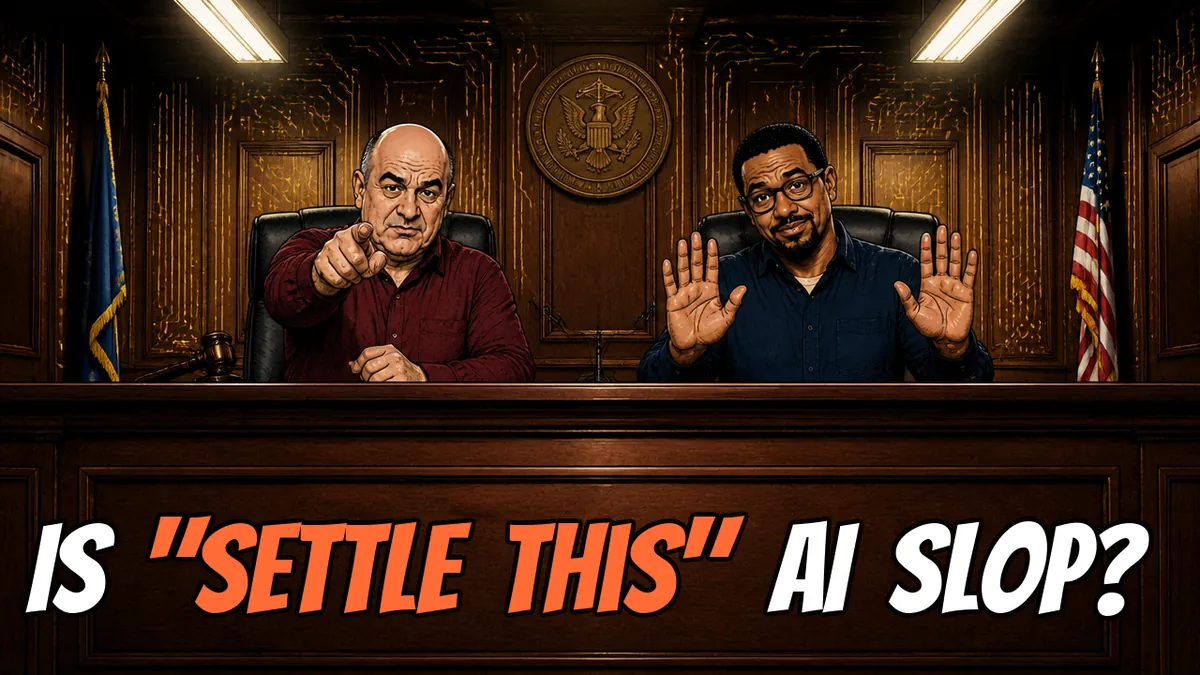
Settle This
Weekly, and a different animal entirely. Shot wide like a television satirical news show, with a proper title sequence, a studio audience that chuckles and occasionally applauds, reaction shots cut in while the other one is talking, and a two-shot finale that puts both of them on screen at once. It costs roughly three times as much per episode (though still less than ten bucks) and it is meant to.
Everything they share, they share properly: the
same characters, the same voices, the same locked look, the same research
layer, the same edit suite, the same publishing desk. What differs is
configuration and a handful of extra layers on the timeline. That is the
actual argument for building it this way — the third show is cheap, and the
fourth is cheaper.
Settle This, the weekend show — taking the question
this page exists to answer.
Step eight, opened up
The edit suite
A real edit suite, an AI editor
Every asset created for the show — the performances, the animations, the title cards — arrives in an editing suite built for this programme and no other. Layers stack the way they would in any professional timeline: the talking heads, visual assets and reaction clips over the top, text cards above those, a title sequence in front, sound underneath it all, and subtitles burned last so they sit on top of everything. And each component can be tweaked and edited before approval.
The difference from an off-the-shelf editing program is that this system knows what a Sal and Eddie episode is. It knows a talking head should not be covered during a punchline, what the safe area is on six different platforms, and where the captions have to sit so a phone's interface does not eat them.
The rule that stops it looking cheap
One example of what "built for this show" buys you. When two visual moments land close together but not quite together, the result reads as a jump cut — a picture appears, vanishes for half a second, another appears. The eye reads it as a mistake even when every individual element is right.
So the timeline enforces a rule: the gap between two visual events is either nothing at all, or at least a second and a half. Anything closer gets closed up; anything in the awkward middle gets pushed apart. It is the sort of thing an experienced editor does by feel and experience, encoded as a set of rules an automatic system can follow. We literally taught the system how to fine cut.
Titles and posters are made here too
The title sequence is not a template with the words dropped in. The bet's question is broken into lines and each line is given a size, so the emphasis falls where the joke is rather than where the line break happened to land.
The covers work the same way. Every episode needs a vertical poster for the phone-shaped platforms and a landscape one for YouTube, both of them carrying the show's look, both built and previewed inside the same system against a simulator that shows what each platform's interface will cover up.
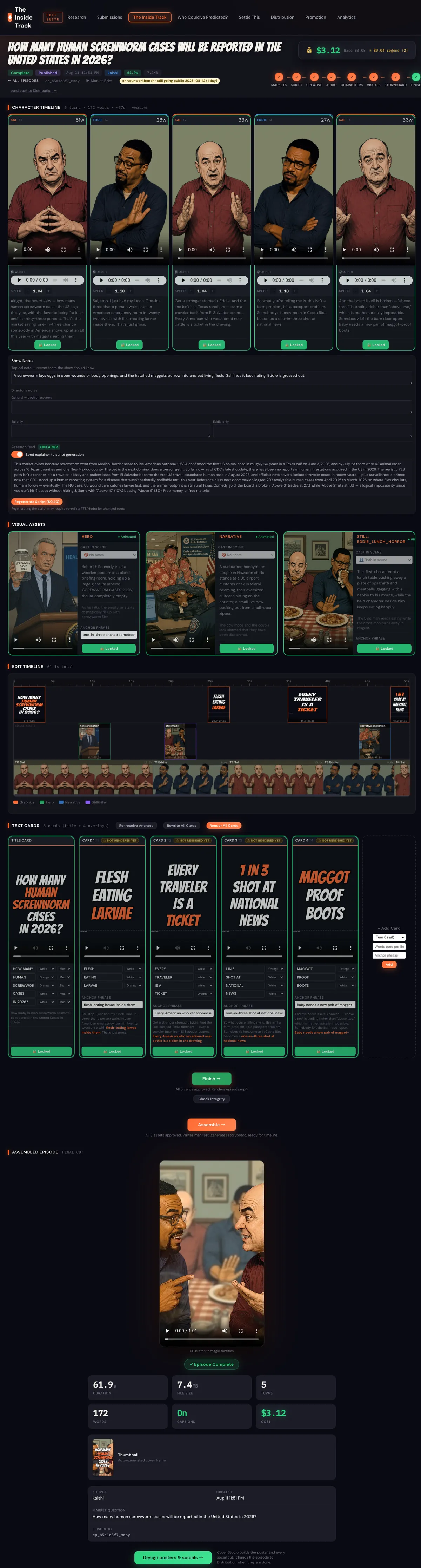
Here is the edit suite with one episode in process. The
real page runs about four times taller than it is wide — the market and its
show notes, five performances with their emotional direction, the research,
the visual assets, the layered timeline, the text cards, then the assembled
episode with its duration, word count and the running episode cost.
The part everyone asks about
Where the machines come in
“It’s AI generated” is both true and
untrue. There are 28 separate specialist roles
in this pipeline that a model does, and they are deliberately not the same
model, because they are not remotely the same kind of work.
1. The Research Desk
Claude Fable reads the market and the news around it and comes back with a brief: who set this price, what moved it, what the small print actually says. It is the only model here chosen for its ability to go and look things up while it is thinking, which for a show about this week’s prices is the entire job. On the weekend show it doubles as story editor.
2. The Writers Room
Claude Opus writes the first draft of everything spoken in character — both men’s turns, the briefs behind them, the strips on the episode pages — and art directs, deciding what each visual should be and what happens in it. Not the most capable model in the building — that one is at the research desk — but the one that writes these two men best, and voice and comic timing are the two things you cannot fake cheaply.
3. The Production Suite
Claude Sonnet does the fast, high-volume work: marking every line for how it should be delivered, proofreading the script for the voice engine, laying out the title and text cards, writing the descriptions and tags. None of it needs judgement, and paying top rates for work that does not need thinking is how a daily show quietly becomes unaffordable.
4. Finishing and Distribution
No model at all. The final render, the crops for six platforms, the captions, the covers and the uploads are plain code running on the server — the same Python the rest of the studio is written in. A large part of what people call “the AI” is, in fact, software doing what software has always done.
Deciding which model does which job is tried and
tested, and getting it wrong is expensive in both directions. Put the cheap
model on the writing and the characters stop sounding like themselves — the
jokes land flat, the voices blur into one another, and the audience can tell
even if they could not tell you why. Put the expensive one on tidying
filenames and you have set fire to the budget for no gain whatsoever.
What no model does, anywhere in the pipeline, is decide. The showrunner
picks the market. He reads the research and throws out the episodes that do
not stand up. He fine tunes the script and visual assets, approves the
performance, and signs off the cut. That is the whole distinction: this is a
crew working for and on behalf of a showrunner.
Under the hood
The machinery itself
Two things had to be held absolutely steady for any of this
to work: how the two stars of the show present themselves, and how the whole
thing looks visually. Almost every technical decision we made exists to
protect one or the other.
A model cannot forget what it knows
Our first attempt at a two-hander was to ask for a conversation. It failed — not because a model cannot write dialogue, but because it cannot un-know things. Tell one model everything and have it play both men, and both have read the research: they reach for the same observations, agree in slightly different words, and the argument dies.
So the turns are written one at a time, on unequal information. Sal gets the full brief — odds, volume, fine print. Eddie gets Sal’s opening lines and nothing else, and is told to react, which is exactly where the audience sits. Call and return, to the end. That gives the argument its spine back, and makes Eddie structurally incapable of misreading the market, since all he has is Sal’s reading of it.
It never pretends to be real
The show has one locked aesthetic, and it is not photoreal on purpose: ink linework over naturalistic forms, flat colour, muted earth tones with a few deliberate saturated accents, real human proportions and no cartoon exaggeration. A talking graphic novel. Nobody watching is ever invited to wonder whether what they are seeing is real. That style direction is pinned to the front of every image generated for the show, so the hundredth episode looks like the first.
The look forced the method
That decision had a cost. No video model can currently generate this style directly from a written description — there is simply not enough of it in the world for one to have learned it. Illustration models can, because graphic-novel art is abundantly represented in what they were trained on. So the show does it in two moves: draw a single frame in the house style first, and a different model is asked only to move what is already in the frame. The look comes from the model that can design it; the motion from the one that can animate it.
Someone has to write the punchline
A model that animates is not a model that is funny. So before either generator runs, the writers room is asked for two things and told they are two things: a STILL IMAGE, under 35 words, describing the moment before something happens — one incongruous element somewhere it does not belong — and a MOTION, under 20 words, which tells the story, or delivers the punchline. Setup and payoff, written as separate instructions, because they are sent to separate machines.
The generators are blind, and they are told so
Neither the illustrator nor the animator knows anything about the show, the bet, or the script. They see the words in front of them and nothing else, so write "a national monument" and you get any monument at all. The instruction is explicit about it: name every person, every place, every object. There is a related trick — real people are named in the still and never in the motion, because the still is what fixes the likeness, and the animator only has to keep it.
Vibecoded and iterated
The studio was built conversationally with Anthropic’s Claude Code — describing what was needed, reading back what it wrote, arguing about it, and keeping what survived. To date, there are roughly 60,067 lines of Python code across 115 modules, none typed by a professional coder.
It runs on a machine in a house
Not a cloud platform, not a rented cluster. A home media server, running everything in one container: the database of every market ever seen, the production line, the editing suite, the dashboards, the scheduler that wakes up and does the daily jobs. When the show publishes at noon, that is a consumer machine in a basement doing it.
The freelancers
Anthropic writes and researches. ElevenLabs speaks. Hedra performs, GPT Image draws and Veo animates. Kalshi, Polymarket, Manifold and Futuur supply the markets. YouTube, TikTok, Instagram, X, Bluesky and Facebook take delivery, all through automated APIs. The studio is the thing in the middle that knows the order to compile an episode and what to do when a piece of it fails.
8 cards — swipe, or use the arrows
A worked example
One man, four stages
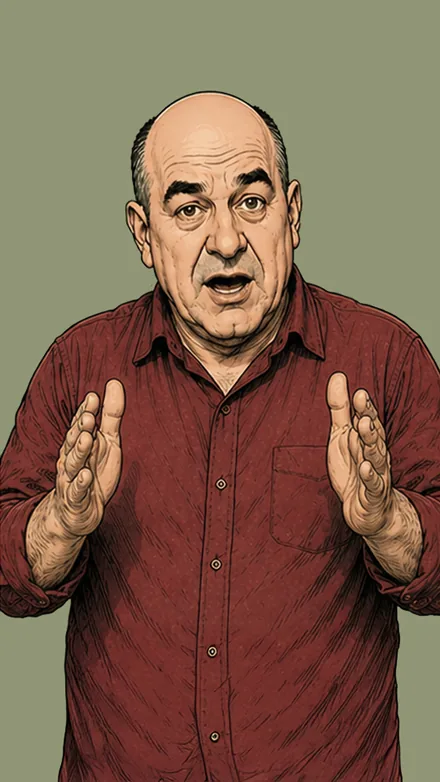
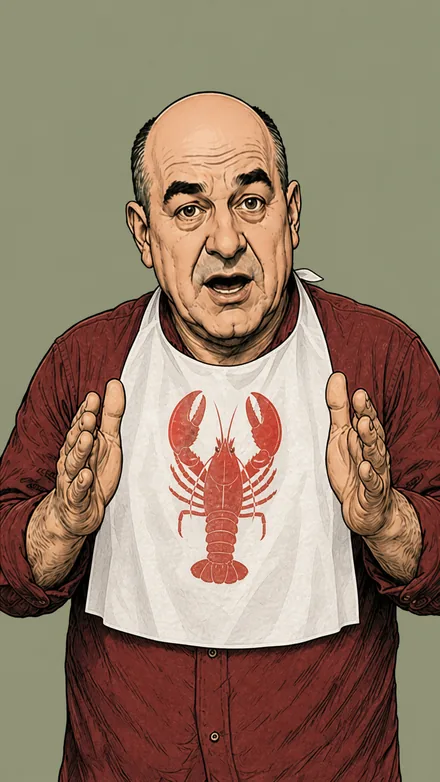
Every frame below is the same character, in the order it actually happens, from the episode asking whether a cotton candy lobster would be caught before 2027.
1A character reference of Sal from our library. There are multiple poses, and the choice can be automated by a custom “emotion caster” working from the script.2The system also allows custom images as a starting point. Here we dressed him in a lobster bib.3Once the audio is generated, it goes to Hedra along with the character reference for animation.4Either character — or both — can also be placed in an animated scene to illustrate the market.
The rules we gave ourselves
Why it is built this way
Most of what makes this work is not the technology, which anyone can buy
or build. It is a short list of decisions taken early and then actually held
to — nearly all of them arrived at by getting something wrong first, in
public, and learning from that mistake.
The show never tips a winner
It would be easy to turn this into a betting-tips channel. It would probably grow faster, and the audience for it already exists. It is not one, and it never will be. The show reads what a crowd of people with money to burn believes, and asks what that belief says about us as a society — which means nobody on screen can win or lose a bet.
The odds you see are the odds we saw
Episodes are sometimes written days or even weeks before they air. Every episode has a permanent page here, and that page shows the board as it stood on the day the script was written, when it went live, and where it is today or when it resolved. If Sal says a market is at 45% and the page says 28%, one of them is wrong in a way that makes a reader distrust everything else on it. The page shows both: what we saw, and what has happened since.
A refusal is the end of it
Occasionally a model declines to research something. When that happens there is no retry, no rephrasing, no routing the request somewhere more permissive. The subject is dropped, the refusal is recorded, and the episode does not get made. Losing access to the tools this is built on, to save a single episode about a single market, would be an extraordinarily bad trade.
Nothing speaks to a stranger unsupervised
On our social channels, Sal and Eddie reply to people who ask questions the show has already answered — that is genuinely useful rather than spam. The machinery finds the candidates, checks them against the episode, and drafts a reply. The showrunner reads every suggestion and posts the ones that are appropriate. Nothing is ever posted automatically to somebody who did not ask for it.
Absence is never drawn as zero
If a price cannot be fetched, the page says so. It does not show a confident nought, or quietly leave the outcome off the board, or fill the gap with the last number it happens to remember. Nearly every serious error this system has produced has been some version of missing information wearing the costume of a real value — a settled market still reading as live, a board silently missing half its runners — and the fix is always the same: say what you do not know.
5 cards — swipe, or use the arrows
The economics
What an episode costs
$3.99a daily episode
$9.16a weekend episode
89episodes made so far
Every generation is logged against the episode it belongs to, so the cost
of a show is a measured number rather than an estimate. That matters more
than it sounds. A daily format only survives if you know what a day costs,
and a format whose costs you cannot see is a format you will eventually
discover you cannot afford.
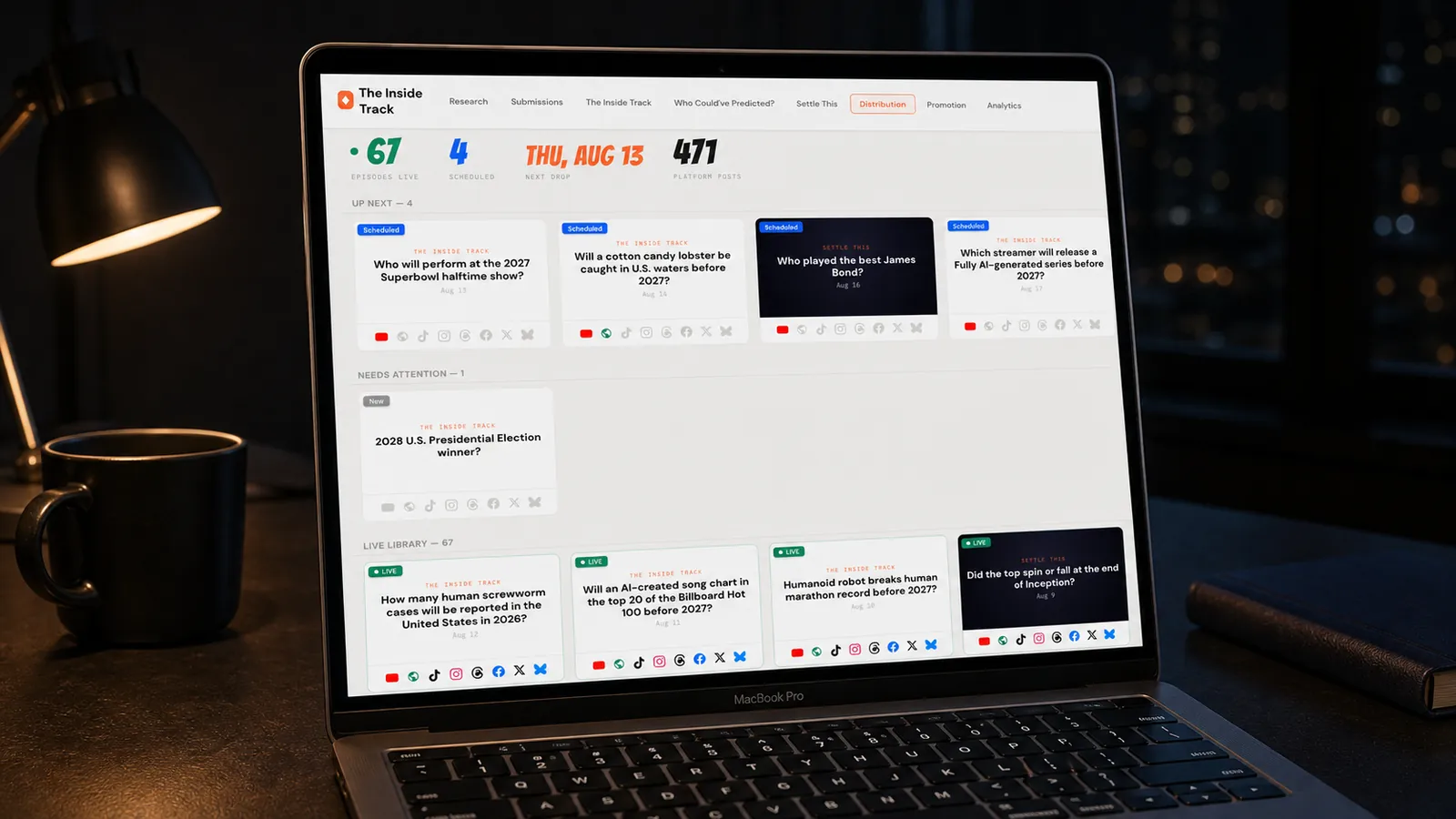
The Distribution board, where every finished episode is
tracked across the platforms it goes out on.
Afterwards
What comes back
Publishing is not the end of the line. Views, watch time, where exactly
people stopped watching, and every reply are pulled back in daily and
attached to the episode that earned them — so the questions that get asked
next are informed by what actually landed rather than by what felt good to
make. Those are not always the same thing, and the gap between them is where
most of the learning is.
The archive compounds, too. Every episode keeps a permanent page: the
board we worked from, why we picked it, what the two of them made of it, and
what the market has done since. Most shows about the future quietly delete
the evidence. This one keeps the receipts, because in a year the interesting
question is not what the odds were — it is whether our take on the market
turned out to be right.
Steve Coulson is the showrunner. Everything on this page — the idea, the
characters, the rules, the studio that makes it — is his, and the daily
decisions that matter are still made by a person at a desk rather than by
anything described above.
He has spent the last 20 years overseeing
immersive
and participatory marketing programs for entertainment properties like
Game of Thrones, Westworld, The Walking Dead, The Purge, Watchmen and Only
Murders in the Building. During the course of that work, he’s
interacted with some of the top showrunners in Hollywood (Jonathan Nolan,
Frank Spotnitz, Benioff & Weiss, Greg Yaitanes) and has learnt from them
how to build a creative team that can bring storyworlds to life.
He’s also been at the forefront of using AI for creative
development, including launching one of the first AI comics series
(The Bestiary Chronicles), which CNET called
“gorgeous”.
The Inside Track, his newest baby, is the natural synthesis of those
experiences.